Editor’s Note: As we mark the second anniversary of the October 7th attacks, our hearts are with the injured, the hostages who have returned, those still in captivity, the families of those killed in the attacks or taken hostage, and all Palestinians and Israelis who continue to suffer or have perished in the war. As we move forward, may we continue to hold empathy for all who have been impacted by this conflict.
Every day, I consume several hours of Israeli and Palestinian media in Hebrew and Arabic on TV, on Instagram, and on Tik Tok. It’s rarely a pleasant experience, but it’s part of my job as a journalist covering the stories from this land. As I see another harrowing picture of a starving family in a Khan Younis tent, or Evyatar David being forced to dig his own grave in a Hamas propaganda video, I wonder how we reached the point where Israelis and Palestinians cause such immense pain to one another?
The day after Tishah B’Av, a day I mourned the suffering of my people across many generations, I came across a deeply troubling poll released by the Israel Democracy Institute. It found that 79% of Israeli Jews reported being “not so troubled” or “not troubled at all” by reports of famine and humanitarian suffering in Gaza.
I imagine an equally large number of Palestinians are not troubled by the suffering of Israeli hostages. It made me think, how can we ever end this war if we can’t end the war on empathy?
In Jerusalem, I work as an education director for an interfaith youth movement for Jewish, Christian, and Muslim children and as a journalist for an Australian newspaper. In both my jobs, I have heard hundreds of stories about how this war has destroyed innocent lives. I have friends whose children were kidnapped from the Nova party and murdered in dark tunnels and colleagues whose extended families were annihilated in devastating airstrikes on Gaza.
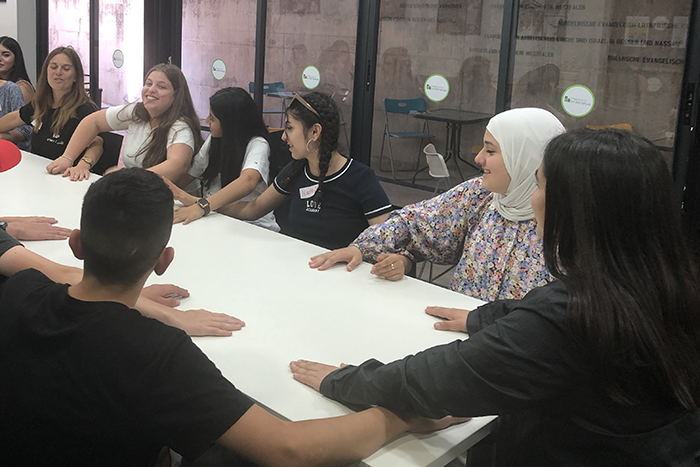
The question of how to ensure Israelis and Palestinians never endure such horror again consumes me daily. While I have no political power, or the ear of anyone who does, what I can offer to this situation is my insight from experiencing and facilitating thousands of hours of Israeli-Palestinian dialogue through my work at Seeds of Peace. These encounters have taught me that of all the factors that make peace impossible, perhaps the greatest is dehumanization. This process of depriving individuals or groups of their human qualities is something I see all around me, and it breaks my heart.
As a result of dehumanization, the vast majority of us believe that the “other side” not only doesn’t want peace, but largely wants our side dead. We tend to think that the “other side” are all liars unless they are proposing views that reflect our deepest fears and stereotypes of them.
Consuming immense amounts of polarizing information on social media causes many to suffer from a fundamental attribution error: we assume that our radicals are exceptional, while the other side’s radicals are definitive. On the flip side, in cases where Palestinian and Israeli civilians or leaders call for peace or empathy, they are branded as liars or traitors who are not speaking the truth about their future dreams. Therefore, a key element for change is adopting a new way of thinking.
For us to share this land, we both must believe when the day comes that we choose to stop inflicting violence, the other side will respond by ending their campaigns of violence against us. Nurturing and spreading this belief was the key to ending the troubles in Northern Ireland, and it is a belief we will need to adopt here.
For Jewish Israelis, this could mean returning to the approach of Rabbi Hillel from the Talmud, who taught: “What is hateful to you, do not do to your neighbor.” For Palestinian Muslims and Christians, this could involve re-embracing the Hadith of the prophet Muhammad: “None of you truly believes until you wish for others what you wish for yourself,” or the words of Jesus: “In everything, do unto others as you would have them do unto you.”
It will mean having more women in leadership positions who can bring a wider array of perspectives and creative solutions to the negotiating table, leading to structural changes that provide security for all.
To stop the violence, we need to believe that there are partners for peace on the other side by embracing shared learning opportunities and building more social, religious, and political institutions based on the principles of justice and equality. Without increasing lived experiences of coexistence, we will always go back to the memories of fear and hatred that have plagued this land for so many years. We also need to rethink how we remember history.
For Palestinians, this would mean believing that Jews in Israel are not colonizers; have a deep, historical connection to this land; and that their security fears are real and not just made up in response to the Holocaust. For Jews, it means believing that Palestinians are a genuine nation with deep roots in this land and an undeniable right to self-determination and freedom in their only homeland.
While I may not have the means to convince most people of these truths today, I firmly believe that if we set our sights on making these beliefs mainstream within the next 10 years, it will be the most effective way to prevent the next war and eventually share this land with peace and dignity for all.
This piece is an adapted extract from Ittay Flescher’s upcoming book, “The Holy and the Broken: A Cry for Peace from a Land That Must be Shared” published by HarperCollins. For further reading and educational resources on peacebuilding, visit ittay.au.
About the Author
Search
Related Posts

From Ancient Ruins to Modern Marvels: 10 Must-See Sites in Israel
5 Life-Changing Reasons to Join Yallah! Israel This Summer