Very few people plan to save a life; but maybe it's time to change that thinking.
As an EMS, international disaster responder, and registered nurse, I often reflect on the work I do - what I offer others, and how I need to train myself to offer it well. These are important questions in these chaotic times.
As I see death and destruction nearly every day-and witness crisis coming to our communities with increasing frequency and severity-it can feel overwhelming. For many, the instinct is to turn away. That response is deeply human. But what if, instead of turning away, those who have the capacity could turn toward the possibility of preparation? What if part of our spiritual and communal responsibility included a plan-however small-to save a life?
Just as our communities work hard to secure our synagogues and sacred spaces, individuals also have the power, and perhaps even the obligation, to take responsibility for the wellbeing of the community.
Areivut is the Hebrew word for mutual responsibility. It expresses the idea that each of us is bound up in the safety, dignity, and flourishing of the other. Jewish tradition teaches that we live not as isolated individuals, but as a covenantal community. The Talmud (Shevuot 39a) states, Kol Yisrael areivim zeh bazeh-all Jews are responsible for one another-which echoes the Torah's repeated call to care for our neighbors, protect the vulnerable, and preserve life whenever possible. In Judaism, saving a life () overrides nearly every commandment; it is the clearest statement that human life is sacred. Simply by asking, "What can I do to help my community be safer?" you are already engaging in this core Jewish value.
There is so much individuals can do - here are some ideas:
CPR Class
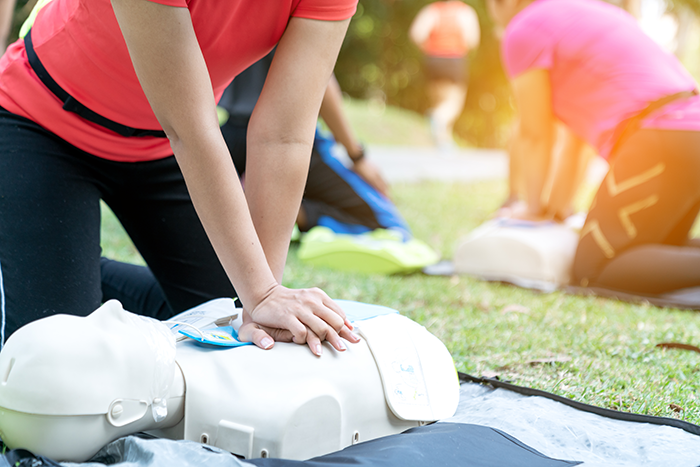
Start by taking a hands-only CPR class. Years ago, bystander CPR was complicated and intimidating, and many people hesitated to act. Today, hands-only CPR is simple, quick to learn, and far more widely taught. In less than 15 minutes, you can learn a skill proven to dramatically increase survival in cardiac arrest.
Start by checking with your local American Heart Association (AHA), local fire departments, community centers, or area hospitals. Many will list upcoming CPR sessions online.
Stop the Bleed Class
You can also take a "Stop the Bleed" class. This program, launched by trauma surgeons and the Department of Homeland Security, teaches how to control life-threatening bleeding using pressure, wound packing, and tourniquets. Like CPR, the skills are simple, accessible, and extremely effective. Visit StopTheBleed.org to locate classes or ask your local fire department or EMS agency. Many community preparedness groups and medical centers also offer these workshops.
AHA Heart Saver Course
Especially for those who regularly engage with communities or crowds, whether in professional settings, at schools and youth activities, as caregivers, or at synagogues , an AHA Heartsaver course is great for building confidence and competence in responding to the most common medical emergencies. This four-hour training is more robust than CPR or Stop the Bleed alone and includes hands-on instruction in using an AED (Automated External Defibrillator), providing basic first aid, recognizing medical emergencies, and responding effectively until professional help arrives. Search for "AHA Heartsaver class near me," or check with hospitals, EMS agencies, or synagogue security committees. Typically, these classes cost between $30-$80 based on the course type and location.
Preparedness is not about living in fear; it's about empowering communities with knowledge and skill. When even a handful of people in a congregation know what to do in the first critical minutes of an emergency, the entire community becomes safer. Imagine the impact if every synagogue had half a dozen members trained in CPR, bleeding control, and AED use. These are small steps with an enormous potential ripple effect.
We enter our sacred spaces seeking peace, comfort, joy, and community. We don't want to imagine that something terrible could happen within those walls. Yet the principle of Kol Yisrael Areivim Zeh Bazeh - "All Jews are responsible for one another" (Shevuot 39a) - reminds us that our covenant of mutual care extends to the most practical aspects of communal life. To me, this teaching means that none of us stands alone in moments of danger or need. Our safety and well-being are interwoven. When we learn to protect one another, we bring this ancient value to life in the most tangible way.
Let's take that sense of responsibility to the next level and be as prepared as we possibly can-so that, should danger come our way, we meet it not with fear, but with readiness, competence, and communal strength.
About the Author
Search
Related Posts

The Jewish Approach to the Male Loneliness Epidemic
God Lives in Memory Care