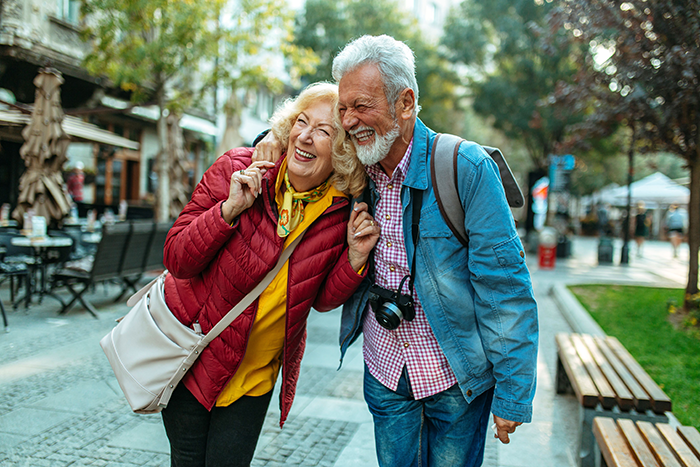
I had heard the folk saying, "Love knows no age." I'd watched sweet, happy-ending movies where two older folks find each other and fall in love. But I'm of the generation where many of us met our partners in college and, if we were lucky - or worked at keeping our marriages a priority as we grew older - had happy marriages.
After my husband died before I turned 70, I joined the sorority that's now so common it has its own name: I became a "solo ager." Yes, I have lots of friends, as well as loving children who have their own children, careers, and live far away. But I missed having someone who cared about the little moments of my life - the one I'd text when my plane landed safely or the one to whom I could complain when the drug store still didn't have the prescription I was promised. But how could I find that one? Friends gave me advice: join a group that does things you like, go online to JDate or Match.com, ask friends to fix you up, reconnect with an old friend on Facebook, or go to your high school or college reunion.
Yes, but... when a friend asked if I was ready to be "fixed up," I was ambivalent. Was I willing to be vulnerable to a stranger? Could I imagine being intimate with someone at this stage, when my body was sagging and I barely looked in the mirror? What if he didn't like me? Could I handle rejection? How would I say no?
"Yes... but" slowly turned to "yes" when I thought of it as an adventure. The worst would be a boring coffee date and an amusing story for my friends.
So I said yes. The friend knew me well enough to know the kind of person I'd enjoy, even if it didn't lead to love. I met Ron, who ticked all the boxes: he was a synagogue member, had his own long, positive marriage, he was a professional retiring to travel, enjoyed culture, cared about politics, he was creative, and he was full of ideas for retirement projects.
Our first date was a beach walk, the second was a backyard picnic, and the third was a movie and takeout at his place. We agreed to take it slow, to wait to introduce each other to family and friends, and talked a lot about our lives, stories, fears, and successes. I shared advice from a friend who'd found love later: keep finances separate and be nice to each other's grandkids.
We kept our homes. We didn't want to remarry or move in with each other. After a few months, we went away for a weekend and came home as a couple.
How do you mark a transition like this? We bought new for each of our bedrooms. Over a week, we added a second mezuzah to each bedroom doorpost (our creative use of a traditional ritual), signaling that these spaces were both sacred to us in new ways and also retained memories of what came before. We wrote intentions on seed paper, shared them, and planted them in pots. After each ritual, we said the .
As I reflect on this journey, I'm reminded that love knows no age - it's a choice we make, every day, to embrace life's possibilities. And sometimes, that means taking a chance on a new adventure, with someone who'll cherish the little moments and the big ones, too.
About the Author
Search
Related Posts
Dying and Living with Dementia

"A New Day": A Poem for the Gift of Living